
Our team of experts offers regular updates on FPE and life safety best practices, code modifications and more.
April 20, 2026
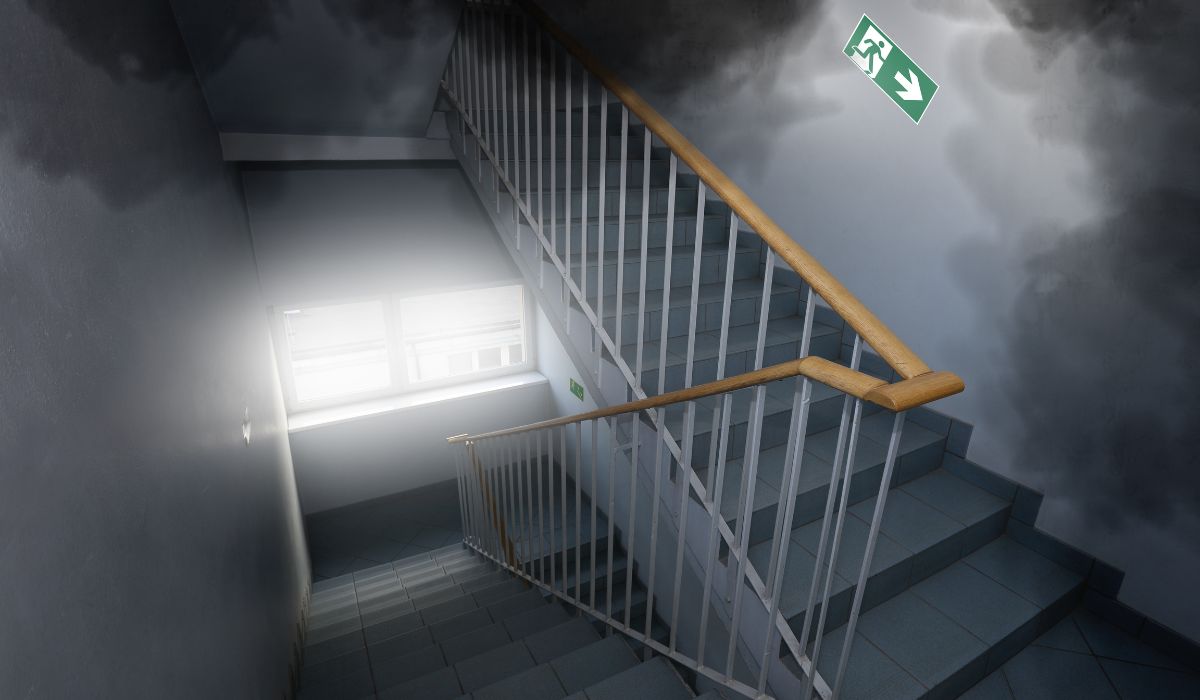
In a high-rise or large complex building fire, flames are rarely the most immediate danger — smoke is. It spreads faster than most occupants can react, quickly filling unprotected stairwells with toxic fumes and near-zero visibility, turning the primary evacuation route into a hazard. Stairwell pressurization systems exist to prevent exactly that.
By injecting clean, pressurized air into stairwell enclosures, these systems create a positive pressure barrier that physically blocks smoke from infiltrating evacuation routes, keeping them clear for occupants escaping down and firefighters pushing up.
For building design, safety, and construction professionals working on high-rises and large complexes, understanding how these systems function, what drives their design, and what the code requires is essential to delivering buildings that perform when it matters most.
During a fire, smoke and toxic gases can compromise designated egress routes such as unprotected stairwells. Pressurization systems combat this and ensure occupants have a safe evacuation path.
The main purpose of stairwell pressurization is to ensure the safety of occupants and firefighters entering the burning building. This process allows stairwells to stay clear of toxic gases or smoke to allow occupants to safely exit the building. Firefighters can also enter and mitigate the fire without risking their own safety, and provide a safer egress path for all occupants, including those with mobility impairments who may require additional time to evacuate.
In relation to other fire protection systems, stairwell pressurization acts as a complementary system. It works in conjunction with fire alarms, sprinkler systems, and other smoke control systems (like atrium exhaust fans) to create a comprehensive safety strategy. This all starts with the smoke control rational analysis, the foundational engineering document that defines how the system must perform.
While sprinklers suppress the fire and alarms notify occupants, the pressurization system maintains the integrity of the escape route against the spread of smoke, which is often the most immediate threat.
The effectiveness of a stairwell pressurization system hinges on the precise control and application of airflow and pressure differences.
When a fire alarm sounds, dedicated fans or blowers activate, drawing clean air from outside the building and injecting it directly into the stairwell enclosure. These systems are designed to overcome environmental stack effect and any natural buoyancy forces caused by the fire, ensuring the stairwell air is constantly refreshed and positively pressured.
The core principle is maintaining a positive pressure inside the stairwell relative to the adjacent, neutral or negative, non-pressurized building floors. Sometimes corridors are even exhausted to assist in complex situations to ensure that the minimum pressure differentials are maintained. This pressure difference acts as an invisible, aerodynamic barrier. Stairwell pressurization systems are mandated by codes like the International Building Code (IBC) Section 909 and NFPA 92 to maintain a positive pressure differential, typically between 0.10 and 0.35 inches water gauge (or) relative to the fire floor. This pressure prevents smoke infiltration while ensuring doors can still be opened.
If a door is opened, the pressurized air rushes out of the stairwell and into the adjacent floor, preventing smoke and toxic gases from migrating in. And when doors are closed, there is still a small airflow through the door cracks, preventing smoke infiltration.
A controlled pressure gradient is critical for both safety and usability. While the pressure must be high enough to resist smoke infiltration, it cannot be so high that it prevents occupants, especially children, the elderly, or people with disabilities, from opening the stairwell doors.
As mentioned earlier, NFPA 92 sets the allowable pressure differential range at 0.10 to 0.35 inches water gauge, but maintaining that range throughout a building is rarely straightforward. Factors like the stack effect, building geometry, construction type, and wind conditions can cause pressure to vary significantly from floor to floor.
This challenge becomes more pronounced in very tall buildings. That's why engineers use computational modeling tools like CONTAM/VENTUS, running multiple iterations across a range of conditions, to ensure a robust system design over many unique conditions. These are exactly the conditions a smoke control rational analysis is designed to account for.
The system relies on several integrated components working together:
READ MORE: When Is Elevator Pressurization Required?
Stairwell pressurization system design depends on building height. Shorter high-rises can often be served by a single-zone system, while taller high-rises require multi-zone designs to combat the stack effect and maintain uniform pressure across all floors.
Effective operation relies on precise technical specifications. Fan capacity is calculated based on CONTAM/VENTUS modeling, and each system includes a VFD to enable fine-tuning of airflow during commissioning. In most cases, that's where active adjustment ends. The system is designed to maintain the required pressure differential without ongoing sensor-driven modulation during a fire event. This simpler approach is intentional: the more complex a system becomes, the more opportunities there are for something to go wrong when it matters most.
Active modulation based on pressure sensor feedback is reserved for special cases where building conditions demand it. Vents and inlets must also be properly placed, with inlets drawing clean air and relief vents preventing over-pressurization when doors are closed.
System reliability depends on two distinct layers of oversight: special inspections and periodic testing. Special inspections are the initial acceptance process required before a stairwell pressurization system can be put into service. A qualified special inspector follows a structured process: reviewing the smoke control rational analysis, developing a test plan, conducting ductwork leak testing, verifying equipment installation, and ultimately certifying the as-built system performance to the fire official.
Once the system passes and the building is occupied, periodic testing takes over to confirm that the system continues to perform as originally designed throughout its lifetime. Both phases include verification of key metrics like door-opening forces and pressure differentials. Together, they form a continuous assurance cycle that ensures the system will function correctly when occupants need it most.
Maintaining the integrity of a stairwell pressurization system is a high priority for fire and life safety. However, these systems are vulnerable to several common issues that can compromise their ability to prevent smoke infiltration and ensure safe egress. Addressing these potential failures requires a proactive approach encompassing meticulous design, planning, and maintenance. In practice, the most reliable systems are often the least complex ones, engineered to perform without active intervention during a fire event.
Stairwell pressurization is a non-negotiable component of modern fire and life safety for high-rise buildings, transforming designated egress routes from vulnerable points into protected pathways. By creating a positive pressure differential, these systems effectively counteract the deadly spread of smoke and toxic gases, ensuring a safe exit for occupants and secure entry for emergency responders. Its complexity demands expert design through CONTAM analysis and preparation of the smoke control rational analysis, supervised installation, special inspections, periodic testing and ongoing maintenance to guarantee reliable function when lives are at risk.
To ensure your building’s stairwell pressurization system meets all regulatory standards and is optimized for maximum life safety, partner with Summit Fire Consulting. Contact us today for a comprehensive system review, to address your fire inspector violation notice, or for a general design consultation.
